(f)air tightness® Membrane STANDARD
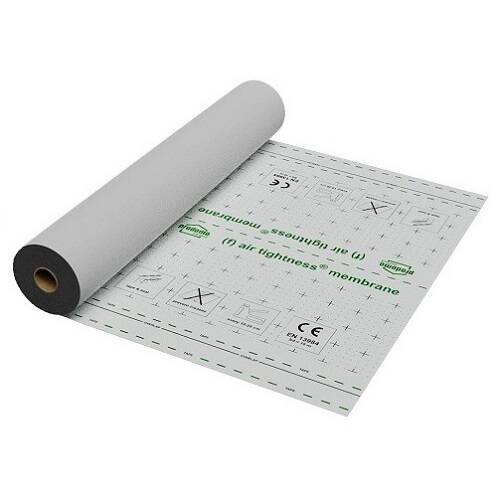
(f)air tightness Membrane STANDARD is an airtightness and vapour control membrane designed for use in walls, ceilings and roof constructions.
It forms part of the building's airtight layer, helping to reduce uncontrolled air leakage and moisture transport through the building envelope.
The membrane is intended for professional installation, with joints, overlaps and penetrations sealed using suitable airtightness tapes and accessories.
PRODUCT BENEFITS
-
Provides an airtight layer for walls, ceilings and pitched roof constructions.
-
Helps reduce uncontrolled air leakage and moisture transport by air movement through the building envelope.
-
Combines airtightness with vapour control on the warm side of the insulation.
-
Suitable for use with compatible airtightness tapes and sealing adhesives.
-
Printed surface provides a useful reference during installation.
-
Suitable for standard applications where additional membrane strength is not required.
-
Practical and economical solution for professional airtightness installations.
APPLICATIONS & INSTALLATION GUIDANCE
Applications
(f)air tightness Membrane STANDARD is designed for use as an airtightness and vapour control layer in suitable wall, ceiling and pitched roof constructions.
The membrane is generally installed on the warm side of the thermal insulation. Its exact position must be appropriate for the building assembly and the intended moisture control strategy.
For constructions where the membrane is subjected to greater mechanical loads, particularly where insulation is not independently supported, (f)air tightness Membrane EXTRA should be considered.
Installation Guidance
Membrane Installation
-
Install the membrane across suitable supporting members, preferably perpendicular to joists or rafters where practical.
-
Lay the membrane smoothly and avoid unnecessary folds, creases and excessive tension.
-
Provide sufficient overlap between adjacent membrane sheets to allow continuous, reliable airtight sealing.
-
Position overlaps so that they can be properly supported and pressed down during taping.
-
Secure the membrane using a suitable fixing method for the supporting construction. Mechanical fixings must not compromise the completed airtightness layer.
-
Ensure that the membrane is adequately supported and protected against damage from insulation, subsequent construction work and other mechanical loads.
Sealing Overlaps and Penetrations
-
Seal all membrane overlaps continuously using compatible airtightness adhesive tapes.
-
Press adhesive tapes firmly onto the membrane using an appropriate application tool to establish reliable contact.
-
Avoid wrinkles, air pockets and unsupported adhesive connections.
-
Seal cable penetrations, pipes and service openings using compatible airtightness tapes, suitable grommets or other appropriate sealing components.
-
Repair accidental cuts, tears and punctures using compatible airtightness sealing materials.
Connections to Adjacent Building Elements
-
Form continuous airtight connections to walls, floors, window and door openings and other adjoining construction elements.
-
Prepare all bonding surfaces according to the requirements of the selected adhesive or sealant.
-
Where suitable, use (f)air tightness OR sealant to connect the membrane to compatible structural substrates.
-
Allow sufficient slack or a movement-relief loop where differential movement between building elements may occur.
-
Avoid placing unnecessary tensile loads on adhesive joints.
Installation During Cold Weather
During cold-weather installation, work in manageable sections and complete the sealing of membrane overlaps, penetrations and perimeter connections before finishing work each day.
Check membrane and substrate surfaces for moisture, frost or condensation before applying adhesive tapes.
Adhesive tapes must be installed within their specified application temperature range. Cold materials and substrates may require suitable conditioning before installation.
Do not apply tapes to wet or frozen surfaces.
Storage and Handling
Store membrane rolls upright in a clean, dry location, protected from direct sunlight, excessive heat and mechanical damage.
Protect the membrane from sharp objects during transport, handling and installation.
Health, Safety and Disposal
Use suitable cutting tools and appropriate personal protective equipment when installing the membrane.
Dispose of membrane offcuts and packaging in accordance with local waste management requirements.
General Installation Note
The suitability of the membrane, adhesive tapes and sealing products must be verified for the intended substrates and construction conditions. Carry out preliminary adhesion and compatibility checks where necessary.
The completed airtightness layer should be continuous, appropriately supported and protected against damage during subsequent construction work.
TECHNICAL DATA
| Property | Value |
|---|---|
| Product type | Airtightness & vapour control membrane |
| Material | Polypropylene non-woven with functional film, two layers |
| Colour | White with black and green printing |
| Roll dimensions | 1.5 × 50 m |
| Coverage per roll | 75 m² |
| Mass per unit area | Approx. 80 g/m² (±5%) |
| sd-value | Approx. 10 m |
| Water vapour transmission | 5–6 g/m²/24 h |
| Air permeability at 50 Pa | < 0.004 m³/(m²·h) |
| Watertightness | W1 |
| Reaction to fire | Class E |
| Tensile strength – MD | ≥ 160 N/50 mm |
| Tensile strength – CD | ≥ 120 N/50 mm |
| Tear resistance – MD | ≥ 100 N |
| Tear resistance – CD | ≥ 100 N |
| Elongation – MD / CD | ≥ 90% / ≥ 90% |
| Temperature range | −40°C to +80°C; +100°C limited exposure |
| UV resistance | Up to 2 months under specified laboratory conditions |
| Relevant standard | EN 13984:2013 |
| Declaration of Performance | DoP 1-1122015-40 |