(f)air tightness® WISA IN – Internal Window Tape
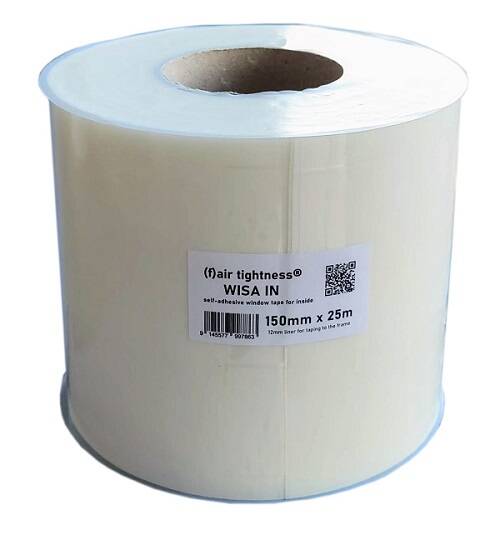
(f)air tightness WISA IN is a fully self-adhesive window sealing tape designed to create continuous airtight connections around windows and doors on the internal side of the building envelope.
The tape combines a synthetic fleece carrier with a solvent-free acrylic dispersion adhesive. Its fully self-adhesive construction allows secure bonding to suitable window frames and adjoining building substrates without the need for a separate application adhesive.
With an approximate sd-value of 30 m, WISA IN provides vapour control at internal window and door connections, helping to limit uncontrolled air leakage and moisture transport through the joint.
WISA IN is intended for installation on the warm, internal side of the thermal building envelope. Suitable substrates include masonry, concrete, plaster, timber, OSB, plywood, metal and uPVC, subject to appropriate surface preparation and adhesion.
PRODUCT BENEFITS
- Fully self-adhesive internal window and door sealing tape.
- Creates continuous airtight connections between window frames and adjoining building elements.
- Approximate sd-value of 30 m for vapour control on the internal side of the building envelope.
- Solvent-free acrylic dispersion adhesive.
- Synthetic fleece carrier for flexible application to suitable construction details.
- Adhesive strength of at least 35 N/25 mm according to DIN EN 1939.
- Durable airtight bonding performance tested according to DIN 4108-11.
- Suitable for bonding to a wide range of properly prepared construction substrates.
- Available in different widths to accommodate a range of window and door connection details.
APPLICATIONS & INSTALLATION GUIDANCE
Applications
(f)air tightness WISA IN is designed for internal airtight sealing around windows and doors in suitable residential and commercial building constructions.
The tape connects the window or door frame to the adjoining internal building substrate, helping to maintain the continuity of the airtightness layer at these important construction junctions.
WISA IN is intended for the warm side of the building envelope. The external connection should be protected using a suitable external sealing system, such as (f)air tightness WISA OUT or WISA OUT PLUS, where appropriate for the construction.
Surface Preparation
- Ensure all bonding surfaces are clean, dry, stable and free from dust, grease, frost and loose particles.
- Remove contamination that could reduce adhesive bonding performance.
- Check the condition of the window frame and adjoining construction substrate.
- Some porous, dusty or difficult substrates may require a suitable primer.
- Carry out adhesion tests where substrate suitability is uncertain.
Installing WISA IN on Window and Door Frames
- Measure the required tape length, allowing sufficient material for continuous sealing around the frame.
- Position WISA IN so that the intended adhesive areas can bond continuously to the frame and adjoining building substrate.
- Remove the release liner progressively during installation.
- Apply the tape smoothly to the prepared frame surface, avoiding folds, wrinkles and unnecessary tension.
- Press the bonded area firmly using a suitable application roller.
- Ensure that the tape remains suitably positioned for the subsequent connection to the adjoining building element.
Connecting to Adjacent Building Elements
- Check that the adjoining substrate is suitable for adhesive bonding.
- Apply the remaining adhesive area continuously to the prepared internal substrate.
- Ensure full contact with the bonding surface and avoid trapped air or unsupported adhesive areas.
- Press the tape firmly across the entire bonded area using a suitable application tool.
- Allow sufficient movement relief where differential movement between the window frame and building structure is expected.
- Avoid continuous tensile or peeling loads on the bonded connection.
Corners and Frame Junctions
- Plan the installation sequence to maintain a continuous airtight connection around the complete frame.
- Allow sufficient material at corners to accommodate the actual geometry without excessive tension.
- Ensure any overlaps are continuously bonded and securely pressed into place.
- Avoid wrinkles, gaps and unsupported folds at corners.
- Inspect the completed connection carefully before covering it with subsequent construction layers.
Connections to Masonry, Plaster and Construction Boards
WISA IN can be bonded to suitable substrates including blockwork, brick, concrete, plaster, timber, plywood and OSB.
Mineral and porous substrates must be sufficiently stable and free from loose particles. Depending on the surface condition, primer treatment may be necessary to achieve reliable adhesion.
The suitability of any subsequent plaster or finishing system must be assessed separately. Airtightness should not depend on an unverified finishing layer.
Application Temperature
The specified application temperature range is +5°C to +40°C.
- Do not apply WISA IN to wet, icy or frozen surfaces.
- Ensure that the substrate and adhesive are within the recommended application temperature range.
- Protect the adhesive surfaces against contamination during installation.
- Press all bonded areas firmly to ensure continuous contact.
- Carry out adhesion tests where site conditions are challenging.
Internal Airtightness and Vapour Control
WISA IN is intended for the internal side of window and door connections. Its approximate sd-value of 30 m provides vapour control as part of a suitable building envelope design.
The complete joint arrangement must be appropriate for the intended construction, with due consideration for airtightness, moisture management, movement and external weather protection.
Storage and Handling
Store WISA IN in its original packaging under clean, dry conditions. The technical data sheet recommends room temperature storage at approximately 20°C and 50% relative humidity.
Protect the tape against contamination, direct sunlight, excessive temperatures and mechanical damage during storage.
Health, Safety and Disposal
Use suitable cutting tools and follow normal construction-site safety practices. Dispose of packaging and waste materials in accordance with applicable local regulations.
General Installation Note
The performance of an airtight window connection depends on the substrate, surface preparation, joint design and application conditions. Verify compatibility, carry out adhesion tests where required and protect the completed airtightness system against subsequent damage.
TECHNICAL DATA
| Property | Value |
|---|---|
| Product type | Fully self-adhesive internal window sealing tape |
| Air permeability | Passed – DIN EN 12114 (see TDS) |
| Durable airtight bonding performance | Passed – DIN 4108-11 |
| Reaction to fire | Class E – DIN EN 13501 |
| Vapour resistance (sd-value) | Approx. 30 m – DIN EN 1931 |
| Tensile strength – lengthwise | 170 N/50 mm – DIN EN 12311 |
| Tensile strength – crosswise | 120 N/50 mm – DIN EN 12311 |
| Adhesive strength | Minimum 35 N/25 mm – DIN EN 1939 |
| Temperature resistance | −40°C to +100°C |
| Application temperature | +5°C to +40°C |
| Ageing resistance | Very good |
| Carrier material | Synthetic fleece |
| Adhesive | Solvent-free acrylic dispersion |
| Colour | White |
| Standard roll dimensions | 75 / 100 / 150 / 200 / 250 mm × 25 m (TDS) |
| Recommended storage conditions | Approx. 20°C, 50% relative humidity |